|
Body Piercing Troubleshooting
For You and Your Healthcare Professional
The following information is based on a combination of vast professional
experience, research, extensive clinical body piercing practice, and common
sense. It has been compiled with the input and assistance of medical professionals
who are trained, experienced piercers.
For the Piercee
Choosing a Medical Professional
Medical personnel have tremendous knowledge and experience about issues
relating to the human body, but may not have specific training about this
unique
form of body art. " Care, Maintenance, and Troubleshooting for Body
Piercing” is not yet a course of study for most medical professionals.
As a piercee, you may have more
specific information about piercing than they do. It is up to you to make
certain that your chosen medical professional has access to accurate information
that will assist them in treating you.
Ask these questions before settling on a doctor or other practitioner:
Do they approve or disapprove of body piercing?
Does this doctor have prior experience treating piercings?
Do they have a trusted expert body piercer to consult with, or other resources
for facts and information about piercing?
If the doctor has any questions would they be willing to call your piercer
to discuss it?
You can save yourself an unpleasant, unprodutive experience by avoiding
a physician who is disapproving, unwilling to learn, or does not feel
comfortable with body piercings.
The following are facts about body piercing and body jewelry to share
with your doctor in order to make certain your physician is apprised of
important data that can assist in decision making about your care and
course of treatment.
For the Medical Professional
Troubleshooting
What is normal?
Discoloration
• Can be reddish, brownish, pinkish, or purplish
• Can remain for many months with certain piercings, such as navels
Swelling/Induration
• Localized
• May be significant with oral piercings such as the lip or tongue,
and may last several days immediately following the initial piercing
Excretion
• Exudate of plasma, dead cells, etc.
• Should not be copious in quantity, malodorous, or green
• Will form a small amount of crystalline-appearing crust on the
jewelry at the openings of the piercing
Things to consider when treating a troubled
piercing or considering jewelry removal from
a piercing:
The majority of troublesome piercings can be resolved without the piercing
being lost.
• Advice to simply “take it out” is likely to be met
with resistance from the piercee, and if infected can lead to the formation
of an abscess (see below)
• Changes in aftercare and/or jewelry size, style or material may
resolve the problems for the piercee/patient
• Inappropriate placement can also be the cause of problems. In
this case removal is often required, and if done timely will prevent further
problems
• Even momentary removal of jewelry from a healing piercing can
result in amazingly rapid closure of the piercing, and make reinsertion
difficult or impossible
Ointments used for topical treatment are not preferred for body piercings:
• They are occlusive and can limit oxygen circulation to the area,
tending to delay healing of this type of wound
• They leave a sticky residue that makes cleaning the healing tissue
more difficult
• If necessary, gels, creams, or other water soluble products are
preferred for topical application
• Signs of accumulative allergic reaction to ointments are papules
and redness of surrounding tissue
Inappropriate aftercare is one of the most common
causes of a distressed piercing:
• Alcohol, hydrogen peroxide, Betadine, Hibiclens and/or ointment(s)
are all inappropriate products for body piercing aftercare
• Over-cleaning can irritate piercings and delay healing
• Daily mild, non-iodized sea-salt or normal saline soaks and/or
cleaning with a liquid anti-microbial or germicidal soap once or twice
a day is suggested for body piercings*
• Daily mild non-iodized sea-salt or normal saline rinses and/or
antimicrobial or antibacterial alcoholfree mouth rinses, 4-5 times a day
is suggested for oral piercings*
Jewelry: Materials
• Acceptable materials for wear in body piercings include:
High quality surgical implant grade stainless steel (specifically 316LVM
ASTM F-138)
Niobium
Titanium (specifically Ti6A4V ELI, ASTM F-136)
Solid 14k or 18k white or yellow gold
Solid platinum
Dense, low-porosity plastic such as Tygon or PTFE
• Appropriate jewelry has no nicks, scratches, burrs or irregular
surfaces that might endanger the tissue
• Safety pins and other household objects are never put into piercings
by professional body piercers
• Some piercers use inferior jewelry that contains too much nickel
or other irritating alloy resulting in a “metal allergy” (see
Allergic Reactions)
• Sutures are not an appropriate size or material for wear in body
piercings
Jewelry: Size/Style
• Jewelry in a healing piercing should be of appropriate length
or diameter. Too tight/small jewelry will not allow for air and blood
circulation, some movement during cleaning, and for the expulsion of normal
exudate from the wound. It may imbed, and can increase the possibility
of swelling and other complications
• Jewelry in a healing piercing should be of an appropriate gauge
(thickness). Too thin of a gauge, and the jewelry may be perceived by
the body as a splinter, worked towards the surface and eventually ejected
Jewelry: Xrays, MRIs, and CT Scans
• Metal body jewelry will result in an opaque density on x-rays,
but will not otherwise affect visibility on film
• Nipple piercings are unlikely to obstruct visibility of any pathology
on thoracic x-rays if both frontal and lateral views are taken
• Appropriate body jewelry is non-magnetic, and as such does not
need to be removed for MRI procedures* unless it is located in the region
being examined
• Gold jewelry is much more thermal-conductive than steel
• There is no need to cut body jewelry for removal – see Jewelry
Removal Tips
• Even momentary removal of jewelry from a healing piercing can
result in amazingly rapid closure of the piercing, and make reinsertion
difficult or impossible
Placement:
• Problem: Piercing is placed too shallow or the jewelry is too
small (gauge/thickness)
• Cause:
Result of poor initial piercing placement
Inappropriate jewelry selection (length/diameter)
• Result: Body will work the jewelry towards the surface and eventually
be ejected
• Indications:
Jewelry can be seen through the tissue
Jewelry encompasses less than 1/4-5/16” of tissue
Tissue is red and indurated across the entirety of the piercing and its
placement very superficial
• Treatment: Removal of jewelry prior to ejection is preferable.
If jewelry is removed the holes close up and scarring is minimized. If
the jewelry is allowed to come through the surface by itself a split scar
may remain
• Problem: Piercing is placed too deep or the jewelry is too small
(length/diameter)
• Cause:
Result of poor initial piercing placement (most common)
Delayed complication of swelling
Poor/inappropriate aftercare
Inappropriate jewelry selection (length/diameter)
• Result: (includes but is not limited to):
Prolonged healing time
Impossible to heal
Unnecessary/unusual scarring
• Indicators: (with Ring)
Ring is unable to lay flat comfortably
The tissue takes up more than 1/3 of the ring’s circumference
• Indicators: (with Barbell):
Barpost can’t seen at either end of the piercing
Beads/Ends of the jewelry pinch or actually imbed in the tissue
• Treatment: Replacing of small jewelry for appropriately sized
jewelry. Removal of jewelry to allow healing of too-deep piercing. Can
be repierced at a later date
Infected Piercing:
• Problem: Piercing has been contaminated by pathogenic microorganism(s)
• Causes:
Most Common: Piercee has touched piercing with dirty hands or otherwise
contaminated piercing (exposure to bodily fluids, dirty water, etc.)
Piercing done with inappropriately sterilized tools, needles, jewelry
Piercing done with unclean, ungloved, and/or contaminated gloved hands
• Indicators:
Piercing exudes thick, green, malodorous pus
Piercing and surrounding area is warm/hot to the touch (more so than other
skin)
Piercing site is swollen, red, and painful
• Treatment:
Increased mild sea salt soaks (for minor infections)
Oral/topical antibiotics, as prescribed by a physician
Removal of jewelry in the presence of an infection may result in an abscess.
In the event there is a localized, draining infection, quality jewelry
should be left in place to allow for passage of matter to the surface
• Complications:
Abscesses are usually site specific. An exception is the chest where the
duct system can result in the abscess being formed inches away from the
piercing site.
Allergic Reactions:
• Problem: Metal Allergy
• Cause: Inferior Jewelry used (contains too much nickel or other
irritating alloy)
• Indications:
Tissue appears to “retreat” from the offending metal
Patient may present with complaints of itching, burning and/or tenderness
S/he may feel virtually no discomfort, even though the piercing seems
highly inflamed
In addition to localized dermatitis, the opening to the piercing may
appear significantly larger than the size of the jewelry
Redness where the jewelry rests on the surface of the skin
Granulation tissue will be visible
• Solution/Treatment: Change to an appropriate biocompatible jewelry
such as Titanium; or a dense, low-porosity plastic such as Tygon or PTFE
• Problem: Product Sensitivity
• Cause: Aftercare products are inappropriate, or the piercee has
a product allergy or sensitivity
• Indications:
Delayed healing, localized irritation
Tissue surrounding (up to several inches away) the piercing is red, seeping,
or contact dermatitis is present
Expansion of the piercing channel
• Treatment: Discontinue current care regimen in favor of milder
products and/or less care
Compounded problems: Any one of the above problems can make additional
or secondary problems more likely; i.e. an allergic reaction to an inappropriate
metal can make a piercee more vulnerable to infection or a reaction to
cleaning products. One should be aware when trying to evaluate a troubled
piercing, that multiple causes may be affecting it. In addition, overall
health and stress level can be crucial to the healing process and should
be evaluated and treated as a potential cause for complications with a
healing piercing.
Jewelry Removal
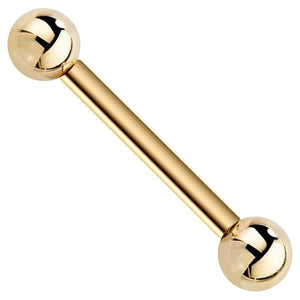
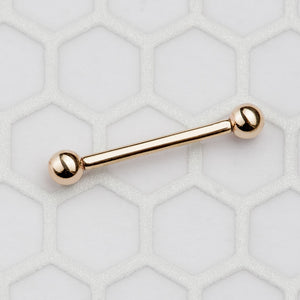
There are three basic styles of body jewelry and many variations on those
styles. The three styles are a bead ring (fig.A), captive bead (fig.B),
and circular barbell/barbell (fig.C).
There is never any need to cut body jewelry for removal. Even momentary
removal of jewelry from a healing piercing can result in amazingly rapid
closure of the piercing, and make reinsertion difficult or impossible.
Removal of jewelry in the presence of an infection may result in an abscess.
In the event there is a localized, draining infection,quality jewelry
should be left in place to allow for passage of matter to the surface.
Fig. A
On a bead ring,the bead is attached to one side of the ring. To open
the ring for removal, simply twist the ring open. Grasp the ring on each
side of the bead, pull gently and one end will pop out of the bead. By
pushing one end away from you and pulling the other end toward you to
open the ring like a spiral.
Fig. B
On a captive bead ring, the bead is held in by the tension of the ring.
Grasp the ring with one hand as close to the bead as you can and with
the other hand grasp the bead. Gently pull the ring and bead in opposite
directions and the bead should snap out of the ring. Twist the ring a
little (as in opening a bead ring) and rotate the jewelry to remove the
ring.
Fig. C
Barbells and circular barbells have threaded ends which can be unscrewed.Like
most threaded objects,they tighten to the right and loosen to the left.On
this type of jewelry one or both of the ends will come unscrewed.
Ring Expanding Pliers or External Snap Ring Pliers can be used to spread
a ring open enough to pop a bead in or out.Place the head of the pliers
inside of the ring and gently squeeze on the handle to spread the jaws
outward,opening the ring just enough to pop the ball out.
Please refer to the APP Aftercare Guidelines sheets (oral or body &
facial) for detailed information on the approved and accepted means of
optimally caring for healing piercings.
DISCLAIMER
These guidelines are based on a combination of vast professional experience,
common sense, research, and extensive clinical practice. This is not to
be considered a substitute for medical advice from a doctor. Be aware,
however, that many doctors have no specific training or experience regarding
piercing and may not be educated on how to best assist you.
Copyright © 2000, by the Association of Professional Piercers, any
changes or deletions are strictly prohibited and must be approved in writing
by the APP.
IMPORTANT HEALTH CONSIDERATIONS
(From the APP Manual, Pg. 36, containing important information for both
piercees and piercers)
Sometimes it is inappropriate to perform even the most standard piercing.
A piercer should politely refuse to perform a piercing that could be dangerous,
ill suited, unsuccessful, or for which they are not trained. The following
are examples for which a second opinion, in some cases from a piercing-friendly
physician, may be needed before proceeding:
An individual with heart valve disease (such as mitral valve prolapse)
should consult their physician for prophylactic antibiotics
An individual has a heart murmur, diabetes, hemophilia, auto-immune disorder,
or other medical condition(s) that may negatively influence the piercing
procedure or the healing process
There is an obvious skin or tissue abnormality that may include but is
not limited to rashes, lumps, bumps, scars, lesions, moles, freckles,
and/or abrasions
The client wants to pierce irregular or surgically-altered anatomy, or
the client is unsuited due to occupational, recreational, or environmental
factors
Surface-to-surface, or other frequently unsuccessful (commonly rejected
by the body) piercings
The client has impending plans to become pregnant and wishes to get a
nipple, navel, or other piercing
It is advisable to refrain from piercing during pregnancy to allow the
body to focus on the important, complex, and demanding task that it is
handling already
PIERCING AND HEART CONDITIONS
It is our suggestion that a piercer not pierce any client who has a pre-existing
heart condition without a doctor’s consent and proof of a preventive
antibiotic. These pre-existing heart conditions include but are not limited
to:
-Any client with an artificial (prosthetic) heart valve.
-Any client with damaged (scarred) heart valves caused by a medical condition,
i.e. rheumatic fever.
-Any client with congenital heart defects or heart valve defects such
as MVP (Mitral Valve Prolapse)- Heart Murmur, Valvular Stenosis, Valvular
Regurgitation, or Atresion of one of the valves.
Risks
The major risk for those clients with heart conditions is Bacterial Endocarditis.
This is a serious infection of the heart's inner lining (endocardium)
or the heart valves. This can damage or even destroy your heart valves.
Although rapid diagnosis, effective treatment, and prompt recognition
of complications can lower the risk of mortality, prevention is still
the best option.
The American Heart Association (AHA) indicates that taking your prescription
prophylactic antibiotics one hour before receiving a piercing or Etching
will provide an effective prophylaxis against infection.
***
The AHA also has a downloadable Bacterial Endocarditis Wallet Card available
on their website at www.americanheart.org.
Prevention is Key
If you have to take antibiotics before seeing the dentist for a routine
teeth cleaning, you need to see your doctor and ask him or her about taking
antibiotics before receiving a body piercing. (Piercing is much more invasive
than getting your teeth cleaned.)
After you speak with your doctor, we suggest that you bring in a note
from your doctor approving your piercing, as well as the filled prescription
of antibiotics.
We care about you and your health and wellbeing, and want every piercing
to be safe and fun!
Thanks to Nicole Brown of Budo Studio for researching this topic and
providing information to the APP.
|