PageContent
Gauge Size Chart & FAQ for Body Piercings
What Does Gauge Mean?
Pronounced /ɡāj/), the gauge of a body jewelry piece refers to the thickness of the barbell going through your body piercing. The higher the gauge, the thinner the barbell. For example, a 22G barbell is going to be very thin, and a 14G barbell is going to be thicker. Piercing jewelry ranges in size from 22G - 00G; after 00G, jewelry is measured in fractions of inches in the US and millimeters internationally. You can check out a full sizing chart below.
Why Is The Gauge Of My Piercing Important?
The gauge of your piercing is important for a number of reasons.
First and foremost, you must choose the proper jewelry gauge for the health of your piercing. When you get pierced, the needle with which you are pierced will be a certain gauge. The jewelry that you choose needs to be the same gauge if you want to avoid certain piercing complications, like rejected jewelry.
The gauge at which you’re pierced has to do with the piercing location and how that area heals. For example, your lobes are usually pierced at 20G to 14G. 20G is about the lowest that you should go; any smaller than that, and your body may view the jewelry as a splinter or something similar and try to push it out.
Besides health considerations, you’ll choose your gauge based on aesthetics. In the past, it was more common to pierce your lobe at 20G or 18G. However, now that styles are changing, it’s more common to pierce the lobe at 16G or 14G. This allows thicker jewelry to go into the piercing hole and follows current styles and trends.
Some piercing areas can be stretched to a larger gauge, so if you’re unhappy with the aesthetic of your piercing, you can talk to your piercer about stretching protocols and whether that’s an option for you and your piercing.

What’s The Difference Between Small Gauges And Large Gauges?
Small gauges will have a thinner bar but a larger number (like 20G), and large gauges will have a thicker bar but a smaller number (like 14G). This can be a bit confusing at first, but if you’re not planning on stretching your piercing, then you’ll really just need to remember the specific gauge of your piercing and choose the proper jewelry from there.
What are Gauge Earrings?
The term “gauge earrings” comes from a misunderstanding of the term “gauge.”
It has become common to refer to “stretched lobes” as “gauged ears.” This is incorrect because every piercing has a gauge as gauge refers to the thickness of the piercing hole rather than a description of a specific piercing type.
When someone is asking about “gauge earrings,” they are actually referring to plugs and tunnels, which are the earring types that are worn in stretched lobes. Stretched lobes are lobe piercings that are stretched to gauges that are quite large (up to 00G or even further).
How Do I Know What Gauge My Piercing Is?
Most piercers adhere to a standard size for each piercing, however there are instances where a different gauge may have been used. When in doubt, it's best to visit your piercer and ask them what size they used for your specific piercing. Below is a list of standard gauges for different piercings:
| Piercing | Standard Gauge | Standard Length |
|---|---|---|
| Belly Button / Navel Ring | 14G | 3/8" , 7/16" |
| Nose Piercing | 20G , 18G | 1/4" , 5/16" |
| Tongue Piercing | 14G | 5/8" |
| Cartilage Piercings (Helix, Forwad Helix, Tragus) |
16G , 18G | 3/16" , 1/4" and 5/16" |
| Eyebrow Piercing | 16G (14G is also commonly used) | 1/4" , 5/16" and 3/8" |
| Industrial Barbell | 14G (16G is also commonly used) | 1 1/2" (varies) |
| Labret Lip Rings | 14G or 16G | 1/4" , 5/16", and 3/8" |
| Monroe Piercing | 16G | 1/4" , 5/16" and 3/8" | Nipple Piercing | 14G | 3/8" , 1/2", 9/16" |
| Rook / Conch / Daith | 16G , 18G | 3/16", 1/4" , 5/16" and 3/8" |
| Septum | 14G (16G is also commonly used) | 3/8", 7/16", 1/2", and 5/8" |
| Ear Lobe Piercings | 20G or 22G |
Gauge to Inches & Millimeters Conversions
Please find a conversion charts below for those of you using the metric system.
|
Gauge |
Inches |
Millimeters |
|
22G |
0.025 |
0.64mm |
|
20G |
.032" |
0.81mm |
|
18G |
.040" |
1.0mm |
|
16G |
.050" |
1.2mm |
|
14G |
.064" |
1.6mm |
|
12G |
.082" |
2.0mm |
|
10G |
.102" |
2.5mm |
|
8G |
.125" |
3.0mm |
|
6G |
.162" |
4.0mm |
|
4G |
.204" |
5.0mm |
|
2G |
.250" |
6.0mm |
|
0G |
.312" |
8.0mm |
|
00G |
.375" |
10.0mm |
Leaders In Making Fine Piercing Jewelry

Our Story
Fresh Trends was founded in 2003 in Palm Beach, Florida, when online shopping was still new and high-quality piercing jewelry was hard to find. What began at a dining room table has grown into a brand known for fine, handcrafted gold jewelry made to fit beautifully and last a lifetime.

5 Reasons Why
Customers from around the world return to Fresh Trends not only for our one-of-a-kind designs, but for our integrity — from sustainable materials and ethical practices to meticulous craftsmanship and personal service.
Handmade in the USA
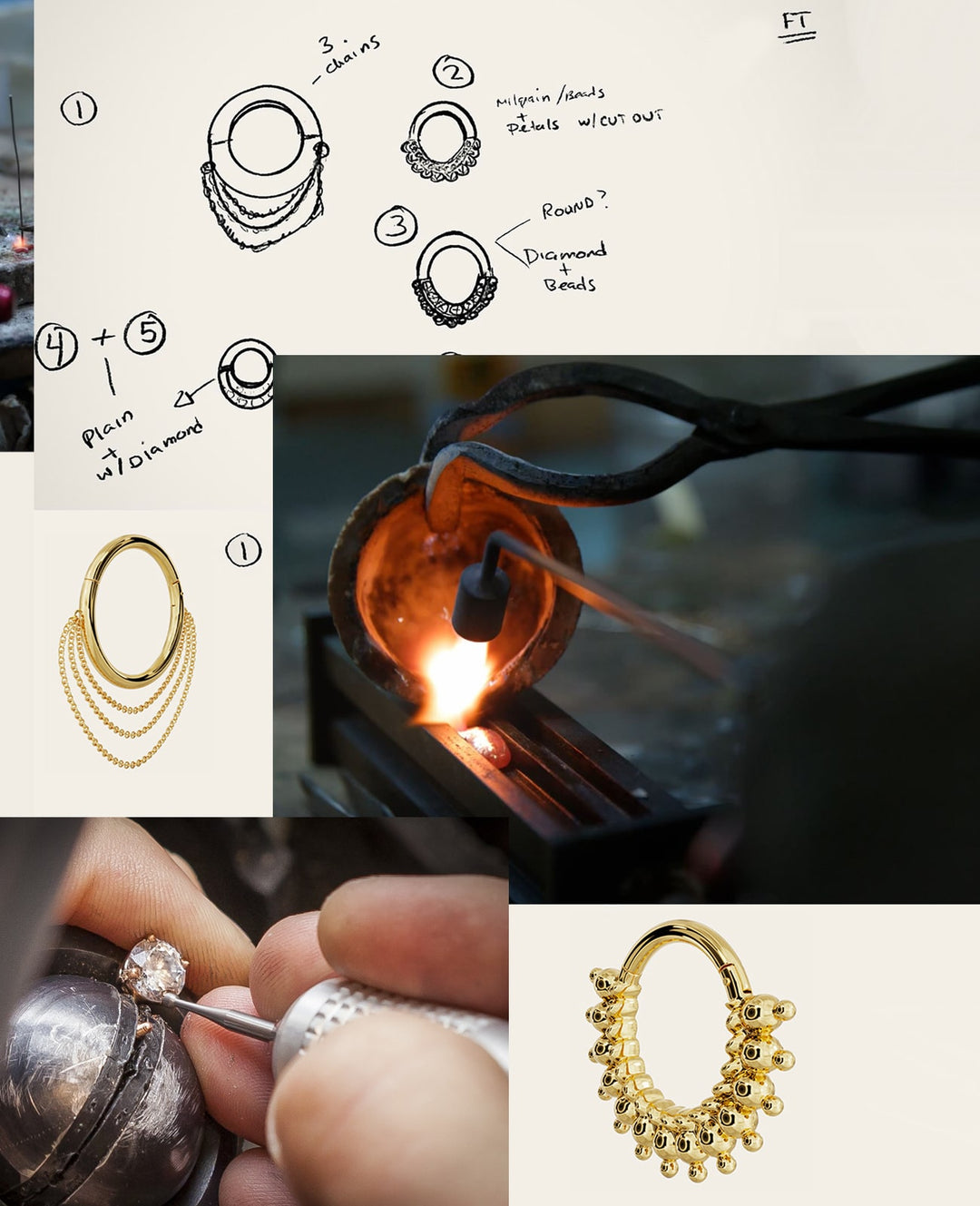
Every Fresh Trends piece is handcrafted in the USA by expert jewelers who specialize in fine body jewelry. When you choose our jewelry, you’re choosing precision, artistry, and a legacy of craftsmanship built to last.